
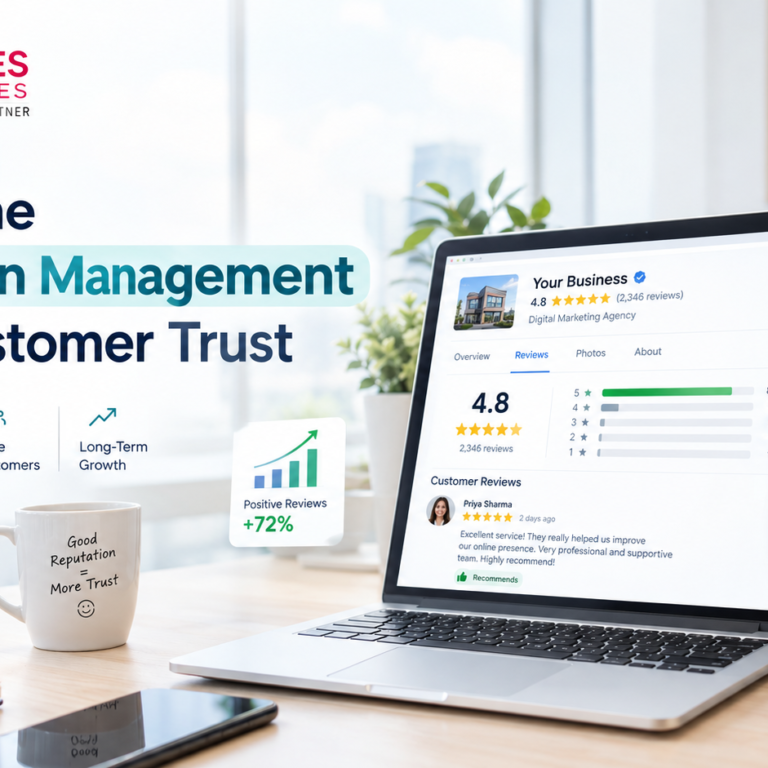
Before a customer ever picks up the phone or fills out a contact form, they’ve usually already checked you out online — a quick scroll through reviews, a glance at your rating, maybe a look at a few photos. Most of us do this without even thinking about it, whether we’re picking a restaurant or hiring someone for a repair job. Businesses tend to underestimate just how much of that decision gets made before any real conversation even happens.
It’s not a minor detail anymore either. Two businesses can offer nearly identical products at nearly identical prices, and the one with a stronger, more visible reputation will often win the customer without any real effort on the sales side. That’s the quiet influence online reputation management has, and it’s what we want to dig into here.
Why Trust Has Become the New Currency Online
There was a time when trust got built face to face — a firm handshake, a referral from a neighbor, a storefront that looked well kept. A lot of that groundwork now happens entirely online, before a customer ever interacts with a real person. Search results, reviews, and social mentions have quietly taken over the job that word of mouth used to do. And because that shift happened gradually, a lot of businesses haven’t caught up to just how much their conversion rates are tied to what a stranger sees in the first ten seconds of searching their name.
The Role of Reviews and Ratings in Buying Decisions
A star rating works like a filter long before anyone reads a single word on your website. Most people won’t even click through to a business sitting below 4 stars, no matter how good the actual service is. It’s not just the average score either — recency and volume matter just as much. Three glowing reviews from two years ago read very differently than fifteen from the last few months. This is exactly the gap that pushes many businesses toward working with the best social media agency in India they can find, since a big part of the modern reputation game plays out on social platforms just as much as it does on Google. At the end of the day, people trust other people’s experiences far more than they trust anything a brand says about itself.
What Shows Up on Google Says More Than You Think
Try it yourself — search your own business name and take a look at what actually comes up. Old news mentions, a forum thread from years ago, review sites, maybe a social post that hasn’t aged well. That first page is basically your reputation snapshot, whether you meant to build it that way or not, and most customers size you up within seconds of scanning it. What catches a lot of business owners off guard is this: if you’re not actively shaping that narrative, someone else already is — a disgruntled ex-customer, a competitor, or just the algorithm surfacing whatever content happens to be loudest at the time.
Handling Negative Reviews and Feedback the Right Way
Nobody enjoys getting a one-star review, but how you respond to it often matters more than the review itself. A calm, professional reply shows every future customer reading that thread that you take feedback seriously and you don’t disappear when things go wrong. This is also where a lot of businesses end up needing outside help — juggling review responses across five platforms while also running the business isn’t realistic for most owners. It’s one of the more common reasons companies start looking into social media marketing companies in India, since consistent, timely responses across every channel genuinely require dedicated attention rather than something squeezed in between other tasks. Whatever happens, don’t ignore it, don’t argue publicly, and don’t try to delete your way out of a bad review — none of those tactics age well.
Building a Consistent Brand Voice Across Platforms
Inconsistency quietly erodes trust in a way that’s hard to pin down but easy to feel. If your Google Business Profile sounds formal, your Instagram sounds casual, and your website reads like neither, customers pick up on that disconnect even if they can’t quite articulate why something feels off. Keeping tone, responsiveness, and messaging aligned across every platform signals reliability — and reliability is basically what trust is built from, one small consistent detail at a time. This applies just as much to how quickly you respond as it does to what you actually say; a brand that replies within hours on one platform and goes silent for a week on another sends a mixed signal customers notice, even if they never mention it out loud.
Proactive vs. Reactive Reputation Management
Most businesses only start paying attention to their reputation after something has already gone wrong — a viral complaint, a sudden review bomb, a bad news cycle. By then, you’re doing repair work under pressure, which is always more expensive and less effective than prevention. A proactive approach looks different: regular monitoring, actively encouraging happy customers to leave reviews, and building a feedback loop before there’s ever a crisis to respond to. This is precisely the kind of ongoing work that the best social media agency in india tends to specialize in, treating reputation as something to maintain continuously rather than something to fix only when it’s already on fire.
The SEO Connection — Reputation and Rankings
Reputation and search visibility aren’t as separate as most people assume. Reviews, mentions, and overall sentiment genuinely influence both local and organic rankings, which means a business with a stronger reputation often shows up higher for the exact searches that matter most. That, in turn, puts you in front of more people who are already inclined to trust what they find — a compounding loop where reputation feeds visibility and visibility feeds more reputation. It’s part of why more brands are folding ORM into the same conversation as SEO instead of treating them as two entirely separate budgets. Even Google’s own local ranking factors quietly weigh review count and rating alongside the usual technical signals, so a page that’s technically well-optimized can still lose out to a competitor with a stronger review profile. Once you see that connection, it’s hard to keep treating the two as unrelated line items on a marketing plan.
Measuring the ROI of a Strong Online Reputation
It’s easy to treat reputation as a soft, unmeasurable thing, but there are concrete numbers worth tracking: review velocity, sentiment trends over time, and conversion rate broken down by star-rating tier. Businesses with a consistently strong reputation tend to see a lower customer acquisition cost over time, simply because trust does part of the selling before a salesperson ever gets involved. It’s one of the reasons several social media marketing companies in India have started reporting on reputation metrics alongside standard campaign performance, treating both as part of the same growth picture rather than separate line items. Looked at that way, reputation isn’t a soft metric sitting off to the side — it’s closer to a long-term asset quietly compounding in the background, the kind of brand equity that firefighting after a crisis simply can’t replace.
Conclusion
Trust isn’t handed out anymore — it’s earned in public, one review, one response, and one search result at a time. Businesses that treat their online reputation as an ongoing practice rather than an emergency fix are the ones customers end up trusting before a single conversation even happens.
Every reply to a review, every consistent post, every quiet bit of monitoring in the background adds up to something a customer can actually feel, even if they can never quite point to the exact reason they chose you over someone else.The businesses that get this right rarely talk about it much, because it doesn’t look dramatic from the outside — it just looks like steady, ordinary upkeep. But that’s exactly why it works.
Nobody remembers a brand that scrambled to fix a crisis after the fact nearly as well as they remember one that seemed to already have things handled. In a market where almost anyone can match your price or your product, reputation quietly becomes the one thing a competitor can’t copy overnight. It’s slow to build and painfully quick to lose, which is precisely why it deserves more attention than most businesses currently give it.
Ready to Take Control of Your Online Reputation?
If you’re ready to stop leaving your reputation to chance, reach out to our team at SEOMines Technologies and let’s start the conversation. Connect with us for a free consultation, or drop us a line to see how we can help protect, manage, and grow the trust your brand has worked hard to earn. Get in touch today — your next customer is already searching for you.